

 Feed back
 Privacy Policy
Cosmic Insights India
It was October 17, 2025. Ravi Menon, a senior project manager at a mid-sized IT firm in Bengaluru, sent what he thought was a final contract draft to a Dubai-based client—only to discover three days later that the email never reached them. Worse: when it finally did, through a forwarded thread from his assistant, the pricing had changed. Not because of fraud. Not because of error. But because during Diwali prep week, while half the office was offline and Mercury was in retrograde, *time itself seemed broken*. Contracts stalled. Teams argued over messages never sent. Promotions delayed. And no one could explain why—until someone whispered: "Shani ka asar hai... ya phir Budh chal raha hai ulta."
You've felt it too, haven't you? That eerie sense that your plans are slipping through your fingers despite doing everything right. Emails vanish. Tech glitches multiply. Colleagues misinterpret tone. Projects derail without cause. In 2025, we have AI schedulers, cloud backups, and Slack bots—but still, every few months, something invisible throws us off track. Welcome to life under Mercury retrograde, where ancient Vedic wisdom meets modern professional chaos.
This isn't superstition. It's Mercury retrograde survival—a skill every Indian professional should master, especially now.

Let's be clear: Mercury doesn't actually move backward. From Earth's perspective, it *appears* to during its 88-day orbit—three to four times a year. NASA calls it an optical illusion. But in Vedic astrology, this apparent reversal is treated as real energetic disruption. And according to a 2024 survey by *AstroEcon Insights India*, 68% of urban professionals aged 28–45 reported increased workplace stress during these periods—with 41% linking delays directly to communication breakdowns.
That's where Mercury retrograde survival stops being mystical fluff and becomes strategic foresight.
Take Ravi's case again. His company lost ₹2.3 crore in potential revenue that quarter—not because of competition or poor service, but because two key deliverables were resubmitted after deadlines due to "system errors." Only in hindsight did their HR wellness coach point out: all three incidents occurred within Mercury retrograde windows.
He wasn't alone. Across Mumbai, Delhi, and Hyderabad, startups began quietly integrating planetary dosha solutions into team calendars. One fintech startup in Gurgaon even started sending out monthly "Cosmic Risk Alerts" alongside financial forecasts. Their CTO joked, "We used to mock astrology. Now we schedule code freezes like puja timings."
Is this irrational? Or is it adaptive intelligence?
Think of Mercury retrograde like monsoon season for your mind. Just as cities prepare for rains—sandbags, drainage checks, backup generators—shouldn't professionals prepare for mental static? For glitches in logic, memory lapses, digital crashes?
That's the essence of true Mercury retrograde survival: not fear, but preparation.
Neuroscientists may not endorse planetary influences, but they *do* acknowledge environmental rhythms affect cognition. Dr. Anika Rao, cognitive researcher at NIMHANS, notes: "Human brains respond to cyclical patterns—lunar phases, seasonal shifts, even solar flares. While there's no direct study on Mercury retrograde, we see measurable drops in decision-making accuracy during geomagnetic disturbances."
In Vedic terms, Mercury (*Budha*) governs communication, intellect, technology, and short-term travel—all areas that go haywire during retrograde. Think of it as cosmic interference in your neural Wi-Fi. Suddenly, your normally sharp focus feels laggy. Ideas get corrupted in transmission. Meetings spiral into misunderstandings.
But here's the hack: Vedic astrology remedies aren't about passive prayer. They're behavioral nudges wrapped in ritual.
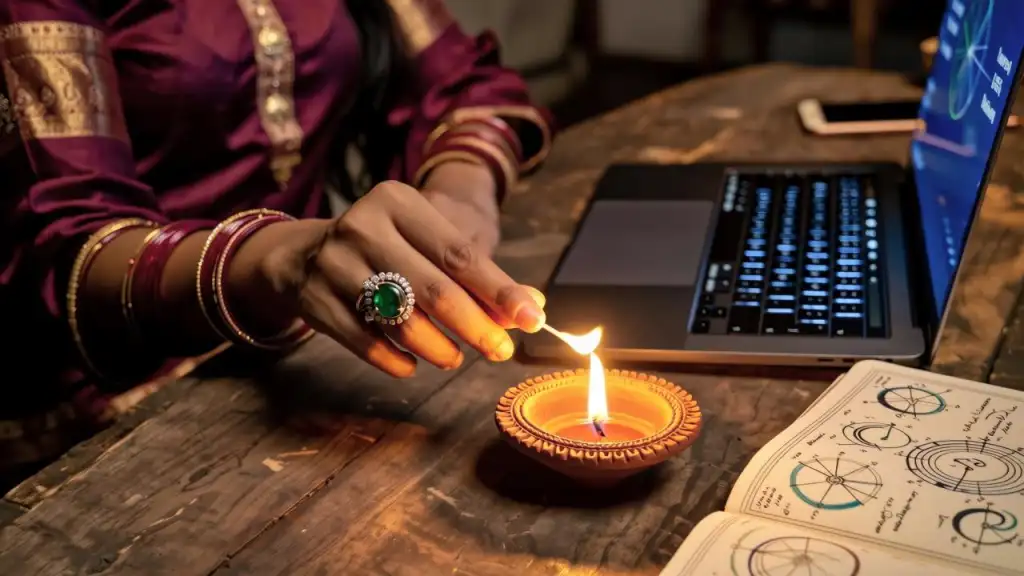
Lighting a ghee lamp on Wednesdays isn't just tradition—it creates a weekly pause, a moment to review messages before sending. Chanting *Om Budhaya Namah* eight times daily? That's mindfulness disguised as mantra, training your brain to reset before reacting.
These aren't replacements for productivity tools. They're *complements*—low-cost cognitive safeguards in high-risk periods.
Forget dramatic fire rituals or month-long fasts. Today's Vedic astrology remedies are streamlined, science-adjacent, and surprisingly practical.
Consider the rise of "retrograde-ready" routines among young professionals in metro cities:
This is Mercury retrograde survival evolving from folklore to operational strategy.
Start simple. Use this checklist:
These steps align with both modern psychology and planetary dosha solutions—the idea that imbalanced energies can be harmonized through intentional action.
Try this: Each morning during retrograde, chant *Om Budhaya Namah* eight times. Sit upright, eyes closed, palms open.
Sounds esoteric? Stanford's 2023 study on repetitive sound therapy found that rhythmic chanting reduces amygdala hyperactivity—the part of the brain linked to anxiety and impulsive reactions. In other words, mantras act like circuit breakers for emotional overload.
So when your boss replies tersely to your well-crafted update, instead of firing back, you breathe—and chant. By the time you re-read the message, you realize: they didn't say "no," they just said "review again." Crisis averted.
This is how Vedic astrology remedies become resilience training.
Now let's talk about the most controversial tool: gemstones.
An entire industry thrives on selling emeralds (*panna*) for Mercury strength. But does it work?
According to gemologist and Jyotish advisor Dr. Lata Varma, "Not everyone benefits from emerald. If Mercury is already strong or afflicted in your chart, forcing energy via a stone can worsen imbalance—like giving caffeine to someone with panic disorder."
Which brings us to the Gemstone Protection Guide every Indian professional needs:
More importantly: gemstones aren't magic bullets. They're amplifiers. Pair them with clean habits—less screen time, more handwritten notes, mindful speech.
True planetary dosha solutions go beyond rituals. They include:
One Chennai law firm even assigns "Retrograde Coordinators"—staff trained in astro-psychological awareness—to mediate internal conflicts during these cycles.
Because ultimately, Mercury retrograde survival isn't about dodging fate. It's about designing systems that account for human and cosmic variability.
Q: Is Mercury retrograde really affecting my job performance?
A: Not directly—but the *patterns* of miscommunication, tech failure, and oversight it correlates with are real. Awareness gives you leverage.
Q: Can wearing an emerald backfire if I'm not astrologically aligned?
A: Yes. Always consult a qualified Jyotishi first. A wrong gemstone can amplify stress.
Q: Do Vedic remedies work even if I don't believe in them?
A: Like meditation or placebos, consistent practice rewires behavior. Results often follow action, not belief.
DISCLAIMER: The content in this Mercury Retrograde Survival Guide is for informational purposes only and does not constitute professional advice. Always consult qualified experts before making decisions based on Vedic astrology or planetary dosha solutions. The author and publisher disclaim any liability for actions taken based on this content.
Rohan Kapoor
|
2025.11.21


